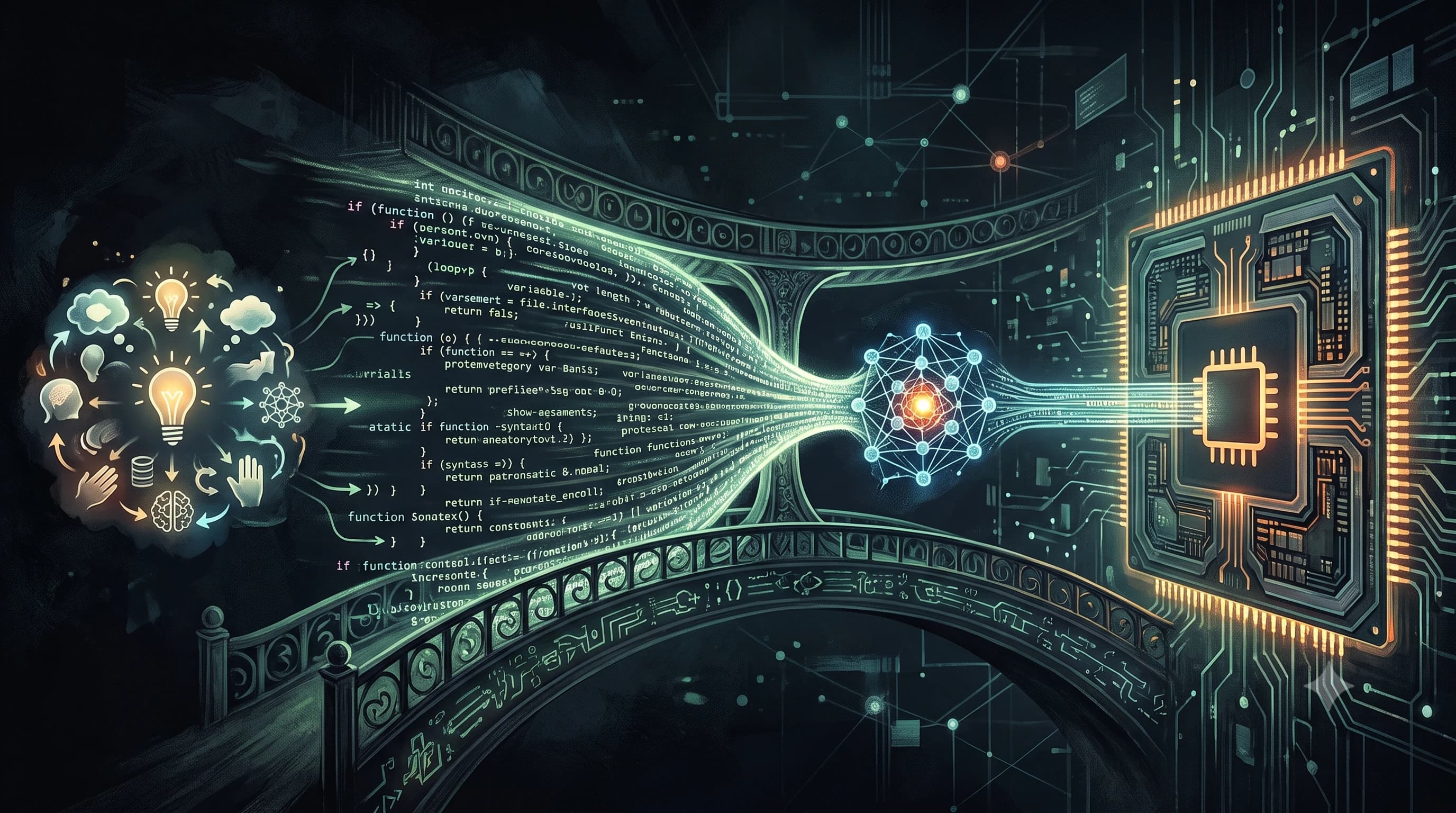
The machine never cared which language you picked

By: Dzhuneyt Ahmed
Posted · 4 min read
For a long time, choosing a programming language was a deeply human decision.
We picked languages for human reasons — safety, expressiveness, what the team already knew. Ecosystem and syntax mattered.
Under the hood, the machine never cared. Compilers and runtimes turn source into something the CPU can execute. Once that translation is done, whether the original was elegant Rust or messy JavaScript is mostly irrelevant to execution.
That was always true. What's new is who sits in the middle of the pipeline.
A history of abstraction layers
Software engineering has climbed a ladder of abstractions. Punch cards gave way to assembly. Assembly gave way to C. C gave way to languages that let you express intent at a higher level — Python, TypeScript, Rust, and dozens of others.
Each rung existed to make it easier for humans to tell machines what to do. Readability, expressiveness, and ergonomics weren't nice-to-haves. They were the design goal.
The compile step was the boundary. Humans worked in the high-level layer. Machines worked in the low-level layer. The source language was a temporary artifact — important to the author, disposable to the hardware.
The pipeline is changing
Agentic coding tools shift who the primary consumer of source code is.
Before: Human writes high-level code → compiler translates → machine runs it.
Now: Human expresses intent (specs, natural language, constraints) → AI generates code → compiler translates → machine runs it.
The human is still in the loop. But the middle step — the actual writing of source — is increasingly machine work.
That changes the optimization target. If the main reader and writer of code is a model, the qualities that made a language pleasant for humans may matter less than the qualities that make it easy for machines to produce, parse, and refactor reliably.
What "machine-optimal" might mean
I'm not claiming we'll end up with one universal language next year. But it's worth asking what a machine-native layer would optimize for.
Token efficiency — saying more with fewer tokens — matters when generation has a cost. Unambiguous parsing matters when the consumer isn't squinting at indentation for meaning. Rich structural information — types, contracts, explicit dependencies — matters when the consumer needs to reason about correctness without intuition.
Human-centric syntax sugar, the kind that exists purely because it reads well to us, starts to look like overhead. Not useless — humans still review, debug, and own what ships — but no longer the primary design constraint.
One plausible future: natural language and structured specifications become the high-level interface. The code underneath becomes more like an intermediate representation — not meant to be beautiful, meant to be generated, verified, and compiled without friction.
What might stay human-readable
Convergence isn't the only outcome. Human-readable languages have survived every previous abstraction shift for good reasons.
Someone still has to review diffs. Someone still answers when production breaks at 2am. Regulation, liability, and team onboarding all push toward artifacts humans can inspect.
So we might keep TypeScript-on-the-surface with something machine-denser underneath. Or human-facing layers that compile down to a shared IR that models prefer to work in. The ladder might grow another rung rather than collapse to one language.
I don't know which way it goes. Both feel plausible from where we stand.
Where the value moves
If this direction holds even partially, the interesting engineering work shifts up the stack.
Less time debating semicolons or framework tribalism. More time on system architecture — how components connect, what fails gracefully, where boundaries sit. More time on guardrails — tests, policies, review gates, observability. More time on intent — writing specs clear enough that generated code actually matches what the business needs.
The skill isn't disappearing. It's moving. From "write the implementation" toward "define the problem well enough that the implementation can be produced, verified, and operated safely."
Food for thought
Programming languages might turn out to be a historical bridge — a set of human-friendly interfaces we built because we were the ones doing the writing.
If machines take over more of that writing, the bridge might thin out, or sprout another layer above it. Either way, the work that compounds probably isn't memorizing syntax. It's learning to express intent precisely enough that whatever sits underneath — one language or many — actually does what you meant.